Aims and Scope
Aims
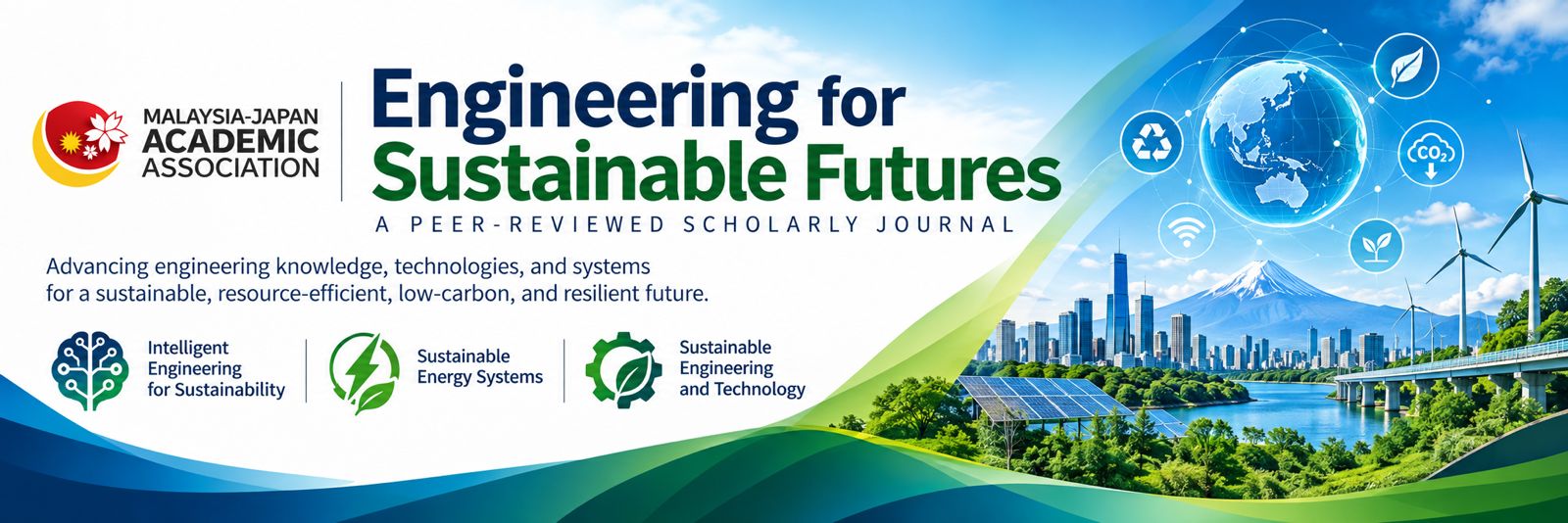
Engineering for Sustainable Futures is a peer-reviewed scholarly journal dedicated to advancing engineering knowledge, technologies, and systems that contribute to a sustainable, resource-efficient, low-carbon, and resilient future.
The journal publishes original research and critical reviews addressing the design, development, integration, optimization, and implementation of engineering solutions for sustainability challenges in energy, industry, infrastructure, transportation, agriculture, water, and the environment.
The journal emphasizes technically rigorous engineering research supported by appropriate modelling, simulation, experimentation, implementation, optimization, or quantitative validation. Sustainability must constitute an integral component of the engineering problem, design objective, methodology, or system performance rather than serving solely as a general application context.
Core Scope
The journal focuses on three interconnected research domains:
Sustainable Engineering and Technology
Research on engineering technologies and systems that improve resource efficiency, environmental performance, resilience, and sustainability, including:
-
Sustainable engineering design
-
Sustainable manufacturing and production
-
Resource-efficient engineering systems
-
Circular engineering and resource recovery
-
Low-carbon and decarbonization technologies
-
Sustainable infrastructure
-
Sustainable transportation and mobility
-
Water and wastewater engineering systems
-
Environmental monitoring and control
-
Sustainable buildings and built environments
-
Climate-resilient engineering systems
-
Life-cycle engineering and assessment
Sustainable Energy Systems
Research on engineering solutions for sustainable energy generation, conversion, storage, distribution, management, and utilization, including:
-
Renewable energy systems
-
Solar, wind, hydro, biomass, and related technologies
-
Electrical power and energy systems
-
Smart grids and microgrids
-
Distributed energy systems
-
Energy storage and battery systems
-
Hydrogen and fuel-cell technologies
-
Power electronics and energy conversion
-
Energy management and optimization
-
Energy efficiency
-
Renewable-energy integration
-
Intelligent energy monitoring and control
-
Resilient and decentralized energy systems
Intelligent Engineering for Sustainability
Research applying intelligent and digital technologies to improve the efficiency, reliability, autonomy, adaptability, and sustainability of engineered systems, including:
-
Intelligent control and automation
-
Robotics and autonomous systems
-
Sensors and instrumentation
-
Embedded systems
-
Internet of Things and Industrial IoT
-
Cyber-physical systems
-
Artificial intelligence and machine learning for engineering
-
Computer vision for engineering applications
-
Digital twins
-
Condition monitoring and predictive maintenance
-
Smart manufacturing
-
Data-driven engineering systems
-
Intelligent resource optimization
Artificial intelligence, machine learning, IoT, and data analytics are considered when they address a clearly defined engineering or sustainability problem and demonstrate a substantive engineering contribution.
Application Domains
Research within the journal's core scope may address applications in:
-
Energy and utilities
-
Manufacturing and industrial systems
-
Transportation and mobility
-
Agriculture and food-production systems
-
Buildings and infrastructure
-
Water and environmental systems
Application-specific manuscripts must demonstrate a substantive engineering contribution through technological development, system design, modelling, optimization, experimentation, implementation, or quantitative validation.
Interdisciplinary Research
Interdisciplinary research is welcomed where engineering constitutes the principal scientific or technological contribution.
Research integrating engineering with environmental science, materials science, agriculture, artificial intelligence, or data science should demonstrate how this integration advances the development, analysis, optimization, or validation of sustainable engineered systems.
Out of Scope
The journal does not normally consider manuscripts primarily concerned with:
-
General sustainability studies without substantive engineering content
-
Business, management, economics, or finance
-
Energy economics or policy without an engineering contribution
-
Social sciences and humanities
-
Law and public policy
-
Education and engineering-education research
-
Pure natural sciences without an engineering application
-
Pure mathematics without an engineering application
-
General computer science or software development
-
AI or machine-learning methods without an engineering or sustainability application
-
Clinical or biomedical research
-
Pure agricultural or biological sciences
-
Descriptive environmental studies without engineering analysis or technological development